
Canadian Building Electrification Economics
Why Canada Needs Ground Source Heat Pumps

Electrification of building heating is a serious financial challenge. Canada has 5.7 million natural gas heated households. Most of those households wouldn’t save money by electrifying with an air source heat pump at current rates. While some individual homeowners might choose to electrify despite increased costs, moral arguments won’t work on most landlords and might annoy homeowners without disposable income. Policies to reduce carbon emissions need to be grounded in real world political and price dynamics. Economists have long argued that taxing carbon is the policy solution to climate change, but carbon taxation of households is politically difficult in practice, having been repealed by Mark Carney’s Liberals. The influence of fossil fuel lobbyists on the government isn’t helping Canada’s climate ambitions, but voters might reject policies that increase household costs even without lobbyist influence.
Calculating whether households will save money by electrifying is largely based on the “Spark Gap”. The Spark Gap is the ratio of the cost of electricity to the cost of natural gas per unit of energy. Electricity is sold by the kilowatt hour (kWh). Natural gas is sold in varied units, including the therm, a unit that contains approximately 29.3 kilowatt hours, the cubic metre, equivalent to 10.55 kWh, and the Gigajoule, or GJ, about 277.78 kWh. The ratio of natural gas to electricity prices, when combined with gas combustion and heat pump efficiencies, determines whether heat pumps cost more or less to operate than fossil fuel equipment.
Gas furnaces and boilers operate at 80% efficiency for standard systems and 90-98% efficiency for high efficiency models. Gas water heater efficiencies range from 67% to 96%.
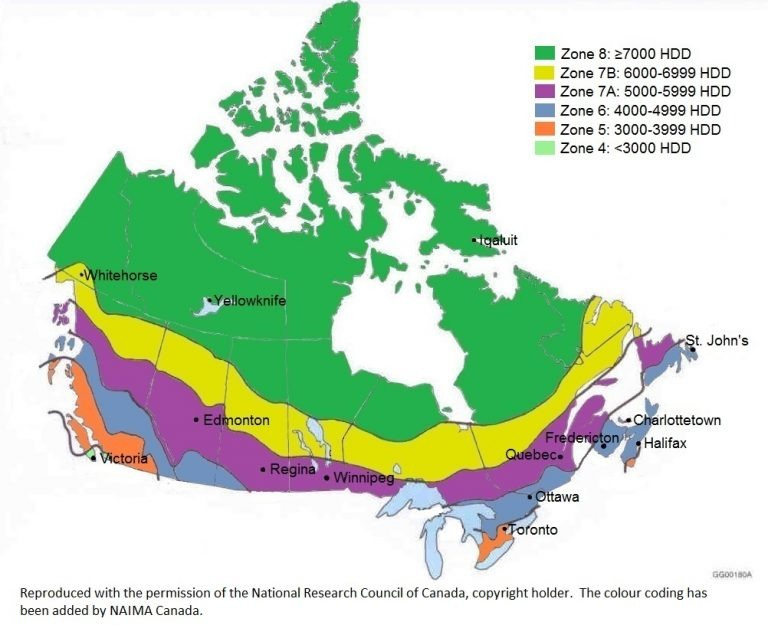
The best widely available single family residential ducted air source heat pumps (ASHP), have an Heating Seasonal Performance Factor (HSPF) rating in climate zone 4 (Vancouver and Victoria) of 11. That’s a Seasonal Coefficient of Performance, (SCOP), of 3.22 (322% efficient over the course of a year) in climate zone 4, and 2.8 (280%) in climate zone 5 (Toronto). Although hybrid systems with backup natural gas heat can save energy in milder weather, air source heat pumps are not the best technology for complete electrification in climate zones 6-8.
For example, if electricity costs 15 cents per kWh, and natural gas costs 5 cents per kWh, then the Spark Gap is 3.
A standard efficiency furnace at 80% efficiency provides heat at 5/.80 = 6.25 cents per kWh of heat delivered.
A standard 8.5 HSPF (Zone 4) heat pump with a SCOP of 2.5 is cheaper to operate than a standard furnace, at 15/2.5 = 6 cents per kWh of heat delivered.
A more efficient 9.5 HSPF system with a SCOP of 2.78 costs 15/2.78 = 5.396 cents per kWh of heat delivered.
A 95% efficiency gas furnace offers low costs at 5/.95 = 5.263 cents per kWh delivered.
The best air source heat pumps, with an HSPF of 11 and SCOP of 3.22, can save money vs. a 95% efficient gas furnace in Zone 4 at 15/3.22 = 4.658 cents per kWh delivered.
The same high efficiency heat pump, installed in Zone 5, with a SCOP of 2.8, doesn’t save in winter vs. high efficiency gas at 15/2.8 = 5.357 cents per kWh delivered.
A ground source heat pump, or GSHP, with a SCOP of 4, has the lowest operating costs at 15/4= 3.75 cents per kWh delivered in this scenario.
What about real world prices? Consider two Canadian households heating with natural gas. One home, in Ontario, is provided gas by Enbridge at approximately 2.2 cents per kilowatt-hour of energy. The other home, in British Columbia, gets its gas from FortisBC at about 4.3 cents per kilowatt-hour of energy. The BC home has cheaper electricity, at 13.13 cents per kWh than the Ontario home at 15.79 cents per kWh.
The Spark Gap is just over 3 for the BC home, and almost 7.2 for the Ontario home. Canadian provincial spark gaps vary considerably, with BC’s average at 2.77, Alberta at 12.44, Saskatchewan at 6.51, Manitoba at 4.14, Ontario at 4.81, Quebec at 1.7, New Brunswick at 4, and Nova Scotia at 1.68. While replacing gas heat with a high efficiency air source heat pump might save a building owner money in BC, Ontario operating cost savings or parity could require a ground source heat pump and other improvements, unless there’s enough cooling savings to offset the slightly higher heating cost. A SCOP 4 ground source heat pump alone won’t save on heating compared to high efficiency natural gas at a spark gap above 4.5.
In order for heat pumps to actually operate at those efficiencies year-round, they need to be sized to prevent the use of COP 1 electric resistance strip heat. Furnaces produce hotter air than heat pumps, so heat pumps need to move more air in order to provide the same amount of heat to a home. Many homes will need either a completely replaced duct system or supplemental distribution, such as radiant heat, in order to provide 100% of the homes’ heating requirements with an efficient heat pump instead of relying on costly electric resistance in cold weather.
A combination of superinsulation and ground source heat pumps is required for electrification to reduce operating costs for Canadians in some provinces. The good news? These improvements can keep electricity affordable to all Canadians. Both superinsulation and ground source heat pumps reduce peak demand in winter. Inefficient electrification significantly increases winter electricity demand, a dynamic referred to as the “Falcon Curve”. Solar output is lower in winter, and other renewables have limited dispatchability. If we don’t invest in our buildings, peak electricity demand will require a lot of costly long-duration energy storage. Electricity prices will be higher in winter than in summer in the future due to the cost of hydrogen, pumped hydro, and batteries to store the energy, and how much higher depends on how efficiently we electrify.
The high upfront cost of deep energy retrofits including full electrification, superinsulation, and geothermal prevent these upgrades from making short term financial sense to individual building owners. A “payback gap” exists between annual savings, which might account for a few hundred dollars, and retrofit costs which are likely to be in the six figures for residential projects that save vs. natural gas heating in a cold climate with a high spark gap. If projects maintain cost parity, but don’t offer savings, building owners won’t invest themselves.
Nationally, how much might building electrification cost? As an order of magnitude estimate of end use residential electrification: 5.7 million homes heated with natural gas times $100,000 per home, representing a combination of GSHPs, distribution, dryer and range electrification, panel and service upgrades, and envelope improvements ranging from insulation and fenestration to ventilation = $570 billion. This gross estimate does not include homes heated with electric resistance, oil, or propane, let alone commercial and industrial buildings. It’s approximately in line with the $25-40 billion per year that taxing fossil fuel exports could generate as revenue.
Canada has budget priorities other than addressing climate change, but the fact remains that building a sustainable energy system that works in the long term is critical for the future of our species. Investing in ground source heat pumps reduces peak electricity demand in winter, minimizing the need for additional electrical distribution and energy storage that would increase the cost of electricity for all Canadians.